Bible study on Exodus 14:19-31
This study can be used by a small group, a household or an individual.
See also our Guidelines for a weekly Bible study including suggestions for adapting it to your context.
Begin with an opening prayer
God who created the world,
we gather here from many places,
be with us here.
God who saves us,
we bring our fears and our questions,
guide us and protect us.
Uniting God, we come as pilgrims to journey together.
Let us know you here as we journey with you.
Amen.
Read the passage
Consider different ways to read the text. For example, hearing it in more than one version of the Bible.
In an online group, you could share parts between those present, or use/adapt this week’s Share the Word suggestion: Use the Jump to this week's menu on the right to go to Share the Word and scroll down to find the Gospel reading.
Explore and respond to the text
Start by reading the Bible notes below. You may want to read them more than once, or pause after each paragraph to reflect on what you have read.
Bible notes
After Passover, Pharaoh finally permitted the Israelites to leave Egypt, but upon learning that the people had left, he changed his mind again. Pursuing the Israelites, Pharaoh’s army ‘overtook them’ (14:9). God had led the Israelites with cloud and fire ‘by the roundabout way of the wilderness’ (13:18) and told Moses to ‘Tell the Israelites to turn back and camp’ by the sea (14:1). This is war and the fleeing slaves are described as ‘the army of Israel’ (14:20). The ruthless worldly kingdom of Pharaoh is to be defeated so that not only the Israelites but also the Egyptians will know that ‘the Lord is fighting for them’ (14:25).
Just as God had told Moses at the burning bush that he would harden Pharaoh’s heart as part of his plan to display his glory (4:21), once again, we hear that God ‘will harden Pharaoh’s heart… so that I will gain glory for myself over Pharaoh’ (14:4). Pharaoh’s treacherous actions are part of the display of God’s sovereignty, but we are also told that Pharaoh has responsibility in these actions. He himself ‘hardened his heart, and would not listen to’ Moses and Aaron (8:15). God destroyed the Egyptian army only because Pharaoh sent the heavy chariots, with their horses and drivers, into the waves. God also turned the sea into dry land, making way for the deliverance of the Israelites. We also see that Moses and the Israelites had to act for God’s plan to come to fruition, as they walked in faith through the parted waters.
See also:
Reflection
Spend a few moments thinking about what stands out for you from the Bible reading. This idea may help.
When learning to drive in a big city, navigating roundabouts can be tricky. When judging when it was safe to move out onto a roundabout in the middle or left-hand lane (when driving on the left), one driving instructor told new learners to ‘go with’ the vehicle to their right. Although it would block their vision, this vehicle acted as a shield to the oncoming traffic and should only be pulling out if it was clear. In Exodus, God went as a pillar of cloud or fire, both guiding the Israelites and shielding them from the approaching Egyptian army. What might it look like for us to take our cues from God and be shielded by him in our lives?
Questions for reflection
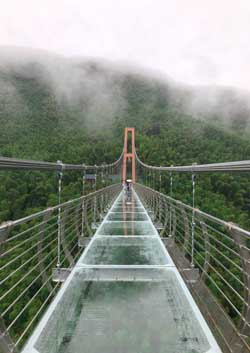
You may wish to use these questions and the picture to help you think about or discuss issues arising from this week’s Bible passage.
 |
Click on the image to view a larger version
or use the Jump menu to go to This week's images.
For artist's details, see this issue's illustrators.
|
Questions
- Would you be willing to walk on this bridge (Zhangjiajie Grand Canyon Glass Bridge, China)?
- When have you stepped out in faith?
- How can you encourage others on their journey with God this week?
A simple activity
Stepping out in faith
You will need: a large piece of blue cloth to represent a river, (optional) a music recording of waves crashing or a song about water.
- Lay the blue cloth in a long line in your space and invite people to stand on one side of it.
- As you play the music, ask people to think of a barrier they (or someone they know) face or a situation they feel trapped in where they would like God’s help. They could imagine the problem as a river they must cross.
- Then ask everyone to imagine God comes and pulls back the barrier as you remove the piece of cloth. Invite them to step through the space where the ‘river’ previously was, asking God to help them trust he can provide a way.
Use the Jump to this week's menu on the right to go to more activities in Explore and respond.
Prayer
Adapt to your local context.
Blessed are you forever, God.
You are with us every step of the way:
raising us up, cheering us on, guiding us,
shaping us, teaching us and drawing us closer to you.
With the dawn chorus of the waking birds
and the sparkling of the evening stars,
we will always praise and worship you.
Ready to follow wherever you lead.
In Jesus’ name.
Amen.
Use the Jump to this week's menu on the right to find more prayers,
including up-to-date intercessions.
A prayer to end the Bible study
Let us have courage,
as we know God before us.
Let us have faith,
as we know God beside us.
Let us have joy,
as we know God behind us.
Let us have love,
as we know God goes with us.
Amen.
Go with God 24/7
Encourage everyone to put their faith into action.
Go on a prayer walk around your neighbourhood and notice where there are barriers people face. These might be clear physical barriers, such as raised pavements that restrict wheelchair use, or less overt barriers, such as access to GP appointments or children who struggle to attend school due to anxiety. Pray for God to open the way for those facing these barriers.
Encourage everyone to explore their faith this week with the Thrive resource [ADD LINK].