 |
Bekah Legg, CEO of Restored, writes about the importance of acknowledging that domestic abuse happens to churchgoers too. Restored is a Christian charity speaking up about violence against women, and equipping churches to stand against domestic abuse and support survivors. |
WARNING: This article contains references to sexual abuse and violence, which some readers might find distressing.
‘We must do something! So speak up!’ (NIV). These are the words of the people of God as they gathered in horror after an act of unspeakable violence. In Judges 19:30, a woman, neglected and rejected by a husband who valued his own life above hers, had been gang raped and killed. God’s people came together, grief-stricken and outraged.
What happened in the time of the Judges to a woman whose name we never hear galvanised a society that, during this period, had drifted further and further from God. That drift can be documented, terribly, in the lives of the women in Israel. The whole book of Judges recounts the treatment of women spiralling into a Godless abyss, with this woman’s abuse and death at the very bottom.
When I imagine that scene, the people of God coming together in holy horror and grief, I see it a little like the scenes we witnessed after the murder of George Floyd in 2020, or the vigil on Clapham Common after the murder of Sarah Everard in 2021. A collective outpouring of grief and anger as one person’s story comes to represent so many more.
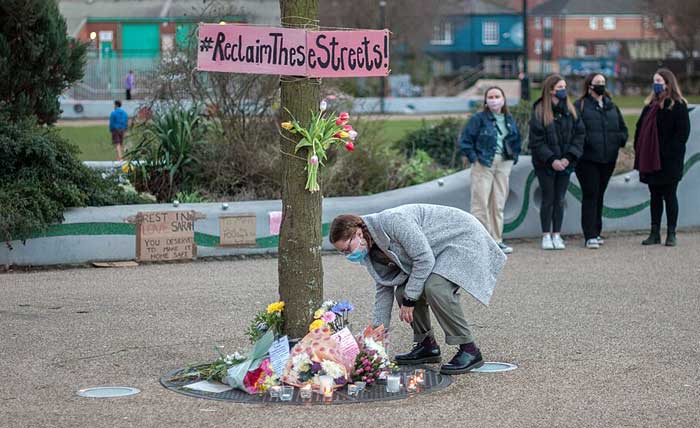 Tim Dennell, CC BY 2.0 via Wikimedia Commons
What happened to George Floyd was wicked in and of itself, but it resonated with the everyday experience of black men and women, all around the world. What happened to Sarah Everard did the same for women. It can be easy to categorise abuse only in these extreme forms, but the stories of people like George Floyd and Sarah Everard are powerful because they represent a broader experience of victims who live their daily lives subjected to a level of abuse or fear of abuse from others.
Today, it’s easy to distance ourselves from that story in Judges 19. It happened 3,000 years ago in a time we see as ‘more barbaric’, with people who weren’t ‘like us’. We like to think we would never do something like that, that it couldn’t happen in today’s world, to women and girls we know.
But it does. According to UN statistics from 2023, 840 million women worldwide have experienced physical or sexual abuse. That’s one in three.
In the UK, around 150 women are killed by men every year. 61% of these victims are killed by a current or former partner. The majority of women killed know their aggressor (with only 6% killed by strangers). That means every two to three days, a woman is killed by someone she knows. Someone who was meant to love her – husbands, partners, fathers, brothers, sons. One in four women will be subjected to domestic abuse at some point in their lifetime.
Women are still being neglected and rejected, their lives are still valued as less than the men around them, and they are still being subjected to sexual and physical violence. It happens on our streets, and it happens in our homes.
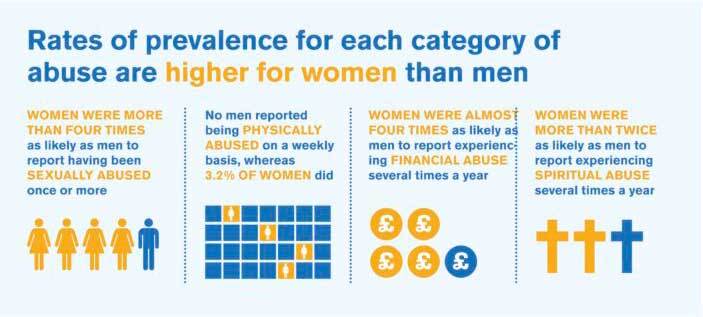 And, it happens in our churches.
That’s not a sentence I enjoy writing. But Restored, together with the University of Coventry and the University of Leicester, conducted research in 2018 that showed that one in four churchgoers has experienced abuse in a current relationship. This means we probably all know someone who has experienced this… or is experiencing it.
One in four, that’s the same figure as outside of the church. Most of us don’t like thinking about it; we don’t want it to be true, so we look the other way. It’s time to turn our eyes and recognise the problem so that we can be part of creating a culture that stands against abuse so that our churches become places of safety and refuge. We want our churches to be communities that model the kinds of relationships that reflect the love of Christ to the world around us.
We need to speak up and do something, and we can start right where we are. Our research suggested that domestic abuse is a great taboo in many of our churches. Nearly 60% of respondents had never heard domestic abuse mentioned in a sermon; most churches don’t have information about where to go or who to speak to if you're being subjected to abuse. Stories of violence against women, like the one I began this article with, appear in our Bibles, but don’t appear in the Revised Common Lectionary. Those stories show that God sees, knows and cares when his people are wounded and violated; we mustn’t edit them out of our Christian conversation. The unspoken message when we do is that we don’t see, we don’t know, and perhaps worst of all, we don’t care.
Ensuring that domestic abuse isn’t a taboo doesn’t mean that we have to centre a whole sermon around it. It might be something we reference when we talk about the fruits of the Spirit: One of those fruits is self-control, we could point out that we’re not meant to control others, and that when this happens in relationships, it’s abuse. Or, if we’re talking about forgiveness, we could ensure that we send the message that forgiveness doesn’t mean continuing to let someone cause us harm, no matter what our relationship with them.
Disclosed or suspected abuse must be referred to those with the appropriate training for further investigation, but this does not mean that churches cannot take concrete steps to support those suffering abuse alongside this. We can pray for those suffering abuse during intercessions, raise funds and awareness of our local refuge, and signpost to local services. There is a free poster available to download from the Restored website to put on the back of toilet doors that will not only enable people to find important information in a safe place, but show that as a church, you see, you knowand you care. Domestic abuse is not taboo in this place.
Our research also showed that only two in seven of the Christians surveyed felt their church was adequately equipped to deal with a disclosure. We can change that and choose to get educated, choose to train our teams and make sure that people know we’vedone it. Simple steps that might give someone the confidence to let you know that all is not well. Every church is required to have a designated safeguarding officer, with each denomination having clear safeguarding policies, training and procedures for how to respond when a disclosure is made or if abuse is suspected. It isn’t a comfortable topic to get educated about, but better awareness and training help keep more people safe and provide better support for those facing abuse.
 At Restored, we are passionate about churches standing against domestic abuse and supporting survivors. We provide training online and in person to equip the church to recognise and respond to domestic abuse. We are also developing a network of churches, Restored Beacons, who choose to purposefully partner with us in not just supporting survivors, but challenging and changing a culture that normalises domestic abuse. Below are some suggested actions for your church to take if they haven't done so already.
- Do you know your own denomination's safeguarding policies and training requirements? Could you invite more people to do the training so as to communicate its importance and equip more of your congregation.
- Do all staff and volunteers receive safeguarding training? Are they aware of different types of abuse and how to respond to a disclosure or report suspected abuse?
- Is information about support for those facing abuse readily available in your church? Is there a picture and number for your designated safeguarding officer accessible to anyone who might need support). Could you put up posters from charities such as Restored in noticeable places?
- Have you addressed the taboo of abuse by referencing it in preaching, highlighting the work charities are doing to combat abuse or including the issue in prayers and intercessions?
Not a Roots subscriber?