Talking about money can be uncomfortable. Looking closely at church finances or our own personal use of money can lead to challenging questions and stir up all kinds of emotions. It can also feel daunting to engage in bigger conversations about the economy.
JustMoney Movement wants to change that. We want to see more Christians and churches using money for good and helping shape an economy that is fairer for everyone. As an ecumenical charity, JustMoney Movement works with individuals and churches across the UK to explore the links between faith, values and financial choices. We equip Christians to ask questions, take practical action and speak out for change. We advocate for a just use of money by banks, businesses and in the tax system in order to shape a fairer, greener future.

Jesus didn’t shy away from talking about money or challenging economic injustice. In his parables and in his encounters with those around him, he demonstrated a deep concern with how money is used and shared. At the beginning of his ministry, Jesus declared that he had come to bring ‘good news to the poor’ (Luke 4:18). He told a rich man to sell his property and give to the poor (Matthew 19:21), and he overturned the tables of the unjust money changers in the temple (Matthew 21:12-13).
Paul’s warning in 1 Timothy 6:10 that ‘the love of money is the root of many kinds of evil’ is a reminder of the power that money can have over individuals and institutions. In a world where inequality is deep-rooted and growing – the world’s 12 richest billionaires have more wealth than the poorest half of humanity – it’s important for churches to engage seriously with questions about money. Throughout Scripture, there is a consistent call for God’s people to live differently when it comes to money and possessions: to act justly, to resist greed and to practise generosity.
Collectively, churches have a significant financial ‘footprint’ that includes everyday banking, savings and investments, as well as money spent on goods and services. Within church communities, each individual Christian is connected to the wider financial system, for example, through their own banking, pensions and spending choices.
What might it look like to make our money work for justice?
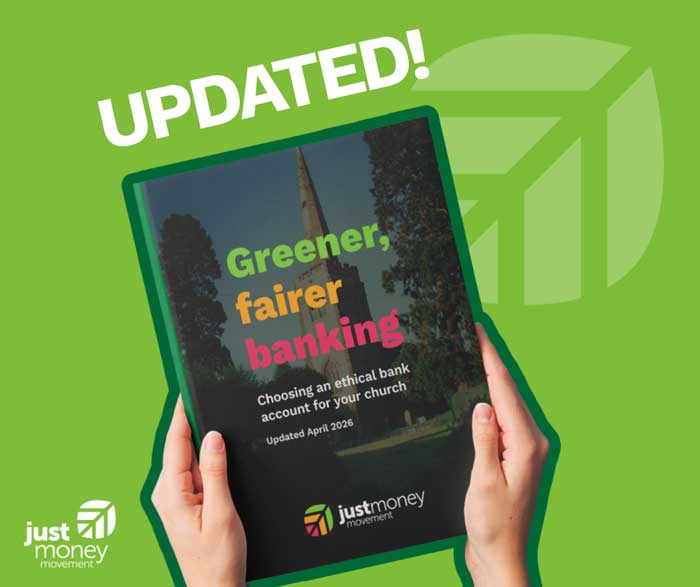
Banking is a good place to start. Many of the UK’s big high street banks lend to and invest in companies linked to nuclear weapons, fossil fuels, gambling and tax avoidance. What do you know about the bank that your church uses for its everyday banking or long-term savings? JustMoney Movement provides a Greener, Fairer Banking Guide to help churches review their banking arrangements and consider ethical alternatives that better reflect their values. Through the Big Bank Switch campaign, JustMoney Movement also encourages individual Christians to explore where they bank and consider switching to greener, more ethical options.
Pensions and investments are another key area to consider. There is £3 trillion in pension funds in the UK alone, and how this money is invested has profound implications for the world that future generations will retire into. JustMoney Movement has been equipping Christians to speak up for greener, fairer pensions, including working with the Student Christian Movement on a resource supporting young adults to ask ethical questions about pensions as they enter the workplace. Institutionally, many churches hold investments at a regional and national level, underpinned by ethical investing policies which should be reviewed regularly. These investments can give access to engaging with companies on issues of concern. If you have a fund manager, you can find out what questions they are asking on your behalf. Even at a very local level and with limited funds, there are ways for churches to invest for positive change, for example, in clean energy or to tackle homelessness.
Our spending choices matter too. The choices that churches make about what they buy and who they buy from have an impact locally and globally. Adopting a questioning approach can help:
- What values are at the heart of our spending choices?
- Do we buy what we want, or what we need?
- What do we know about the businesses we buy from?
Labelling schemes like Fairtrade and the Fair Tax Mark can support more informed and responsible decision-making. Developing ethical purchasing policies can help churches align their spending with their values. Tring Baptist Church, for example, developed their ethical purchasing policy as part of their Eco Church journey. The policy helped to communicate the church’s vision to new members and the wider community and formalised their commitment to purchasing products and services which demonstrate the best ethical credentials, e.g. anti-slavery policy, green policy, recycled packaging.
While individual action is important, churches can wield significant influence when they act collectively, as part of a wider movement. By raising our voices together, engaging with financial institutions and policy makers, and telling a story of a fairer, more just economy, we can contribute to the change that is needed. Prayer, education, campaigning and public advocacy all play a part in shaping a financial system that helps people and the planet to flourish.
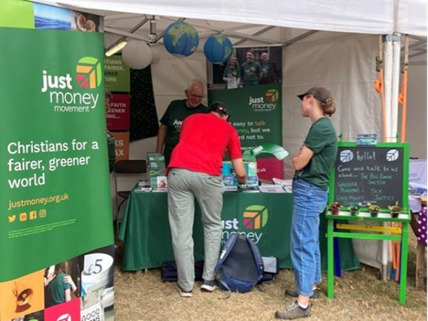
Talking about money within the Church shouldn’t be scary or something to avoid. It’s deeply connected with our faith. It invites reflection on what we value, how we exercise power and responsibility, how we relate to our neighbours and how we share the gifts of God’s creation that are entrusted to us. These are conversations that belong within our churches, within our worship and teaching, within our decision-making structures and wherever we are seeking to follow God’s call on our lives.
- What concrete steps could your church take this year to align its financial practices more closely with its mission and values?
- How could you encourage people of all ages in your congregation to engage more deeply with ethical questions around money?
- And finally, who could you work with in your wider community to call for a fairer, greener financial system?
Find out more
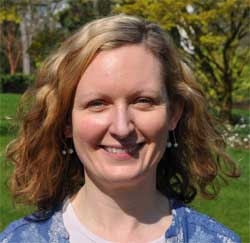 |
Sarah Edwards is Executive Director of the JustMoney Movement, an ecumenical education and campaigning charity which has a vision of a world where money is used to shape a greener, fairer future for all. |
Not a Roots subscriber?